

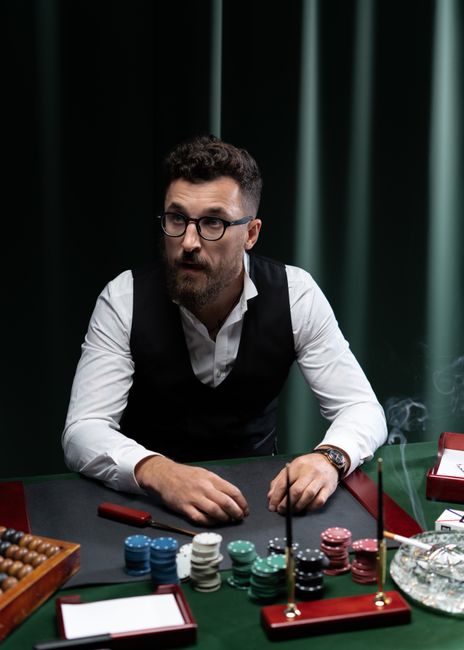
The Real Math Behind Slots, Poker, and Sports Betting
You sit down at a slot machine, feed it a twenty, and watch the reels spin. You know the house has an edge. But do you know exactly how big that edge is? Or how it compares to the edge in blackjack, poker, or a Sunday NFL parlay? Most players don't. They rely on gut feelings and superstition. That's a mistake. Understanding the math won't turn you into a professional, but it will stop you from making terrible bets and help you stretch your bankroll.
Let's break down the real numbers behind the games you play.
House Edge and RTP: The Only Numbers That Matter
Every casino game has a built-in mathematical advantage for the house. That's how casinos pay for the lights, the shows, and the free drinks. This advantage is called the house edge. It's expressed as a percentage of every dollar wagered that the casino expects to keep over the long run. The flip side is Return to Player (RTP) – the percentage of all money wagered that gets paid back to players. If a game has a 96% RTP, the house edge is 4%.
Here's where players get confused. RTP is not a guarantee for a single session. It's a long-term average over millions of spins. You could play a 96% RTP slot for three hours and lose every penny. Or you could hit a jackpot on your first spin. The math doesn't care about your session. It only cares about the aggregate.
Let's compare typical edges across popular games:
- Slot machines (online): 2% to 6% house edge (94% to 98% RTP). Some high-volatility slots go as low as 92% RTP.
- Blackjack (basic strategy): 0.5% house edge. With perfect play, you can get it below 0.3%.
- Roulette (European single-zero): 2.7% house edge. American double-zero: 5.26%.
- Baccarat (banker bet): 1.06% house edge.
- Poker (against other players): No house edge per hand, but the casino takes a rake – typically 5% of the pot up to a cap.
- Sports betting (point spreads): 4.5% to 5% house edge on standard -110 lines.
That spread matters. A $100 bet on a -110 line returns $90.91 in profit, but you risked $100. The implied probability of winning is 52.38%. The true probability is closer to 50%. That gap is the juice, or vig.
Slot Volatility: Why Your $100 Disappears Faster Than You Think
House edge tells you how much the casino keeps. Volatility tells you how the game pays out. A low-volatility slot pays small amounts frequently. A high-volatility slot pays huge amounts rarely. Both can have the same RTP, but your experience will be completely different.
Consider two slots, both with 96% RTP: Before making a choice, it helps to review keonhacaii5.com.co.
- Slot A (low volatility): 40% hit frequency. You win something on 4 out of 10 spins, but most wins are less than your bet.
- Slot B (high volatility): 15% hit frequency. You win on 1.5 out of 10 spins. Most of those wins are small. But one in 50,000 spins pays 10,000x your bet.
If you have a $100 bankroll and play $1 per spin, Slot A might last you 300 spins. Slot B might bust you in 50 spins – or it might turn that $100 into $5,000. High-volatility slots are like lottery tickets with better odds. They're not inherently worse, but they demand a bigger bankroll and a stronger stomach.
Here's a concrete tip: if you want to play high-volatility slots, your bankroll should be at least 200 times your bet size. For a $1 bet, that's $200. For a $5 bet, that's $1,000. Otherwise, you're gambling on a short session, not giving the math time to work.
Poker: The Only Game Where You Can Have an Edge
In slots, roulette, and baccarat, you play against the house. The math is fixed. You cannot change the house edge. Poker is different. You play against other players. The house takes a rake, but your edge comes from outplaying your opponents.
This is why poker is the only casino game where long-term winners exist. A skilled player can have a positive expected value (EV) against weaker opponents. But that edge is fragile. The rake eats into it. A 5% rake up to $5 means that in a $1/$2 no-limit game, you need to win more than $100 pots just to overcome the rake on a single hand.
Let's say you're a winning player with a 5 big blind per 100 hands win rate. At $1/$2, that's $10 per 100 hands. But if you play 30 hands per hour, you're making $3 per hour before tips and rake. After a $5 rake per pot and $1 tips, you might be break-even. This is why professional poker players seek out low-rake games or play online where the rake is capped lower.
For recreational players, the key is to avoid high-rake games. Tournaments often have a 10% entry fee (e.g., $100 buy-in, $90 prize pool). That's a 10% rake – much worse than a cash game. If you're not confident in your skill edge, poker is a losing proposition.
Sports Betting: The Juice Adds Up Fast
Sports betting feels like you're matching wits with the bookmaker. In reality, you're paying a tax on every bet. The standard -110 line means you risk $110 to win $100. The bookmaker's edge is 4.55% on a coin-flip bet. That doesn't sound huge. But over 100 bets, you're paying $455 in juice if you win exactly 50% of your bets. You'd need to win 52.38% just to break even.
Parlays are worse. A two-team parlay typically pays 2.64 to 1. The true odds are 3 to 1 (if each leg is 50/50). The house edge jumps to 12%. A three-team parlay pays 6 to 1, but true odds are 7 to 1 – a 14% edge. The more legs you add, the more the house bleeds you.
Here's a practical tip: if you must bet parlays, use them sparingly and only with correlations. For example, betting the over on a game and the over on a player's passing yards is correlated. The bookmaker might not adjust the odds enough. But in general, straight bets are the only way to minimize the juice.
Bankroll Management: The Real Secret
No betting system can overcome a negative expected value. Martingale, Fibonacci, D'Alembert – none of them work long-term. The only thing you can control is your bankroll management. This is the difference between a fun hobby and a financial disaster.
Here are three rules that actually work:
- Set a loss limit per session. If you sit down with $200, stop when you're down $100. Walk away. The math will still be there tomorrow.
- Bet a small percentage of your bankroll. For slots, 0.5% to 1% per spin. For poker, 5% per buy-in. For sports, 1% to 2% per bet. This keeps you in the game long enough to survive variance.
- Never chase losses. The table doesn't know you're down. The slot machine doesn't care. Increasing your bet size to get even is the fastest way to zero.
Variance is a beast. Even with a 2% house edge, you can lose 20 sessions in a row. A 1% edge player can go broke with bad luck. Bankroll management is your only defense.
The Bottom Line
Casinos and sportsbooks are not charities. They are businesses built on math. You can't beat the house in slots, roulette, or baccarat. You can only manage your exposure. In poker, you can have an edge, but only if you're honest about your skill level and the rake. In sports betting, the juice is a constant drag.
The next time you play, don't think about luck. Think about RTP, volatility, and the house edge. Know the numbers before you place a bet. That won't guarantee a win, but it will make you a smarter player. And in the long run, smarter players lose less – and enjoy the game more.


Stargazing
-
Clear skies, low humidity and minimal moonlight matter more than expensive equipment. Check local forecasts and observe when conditions suit your schedule.


Telescopes




-

Long established fact that a reader will be distracted
-

Long established fact that a reader will be distracted
-

Long established fact that a reader will be distracted



Lunar Phases
Karla Gleichauf
12 May 2017 at 05:28 pm
On the other hand, we denounce with righteous indignation and dislike men who are so beguiled and demoralized by the charms of pleasure of the moment
M Shyamalan
12 May 2017 at 05:28 pm
On the other hand, we denounce with righteous indignation and dislike men who are so beguiled and demoralized by the charms of pleasure of the moment
Liz Montano
12 May 2017 at 05:28 pm
On the other hand, we denounce with righteous indignation and dislike men who are so beguiled and demoralized by the charms of pleasure of the moment